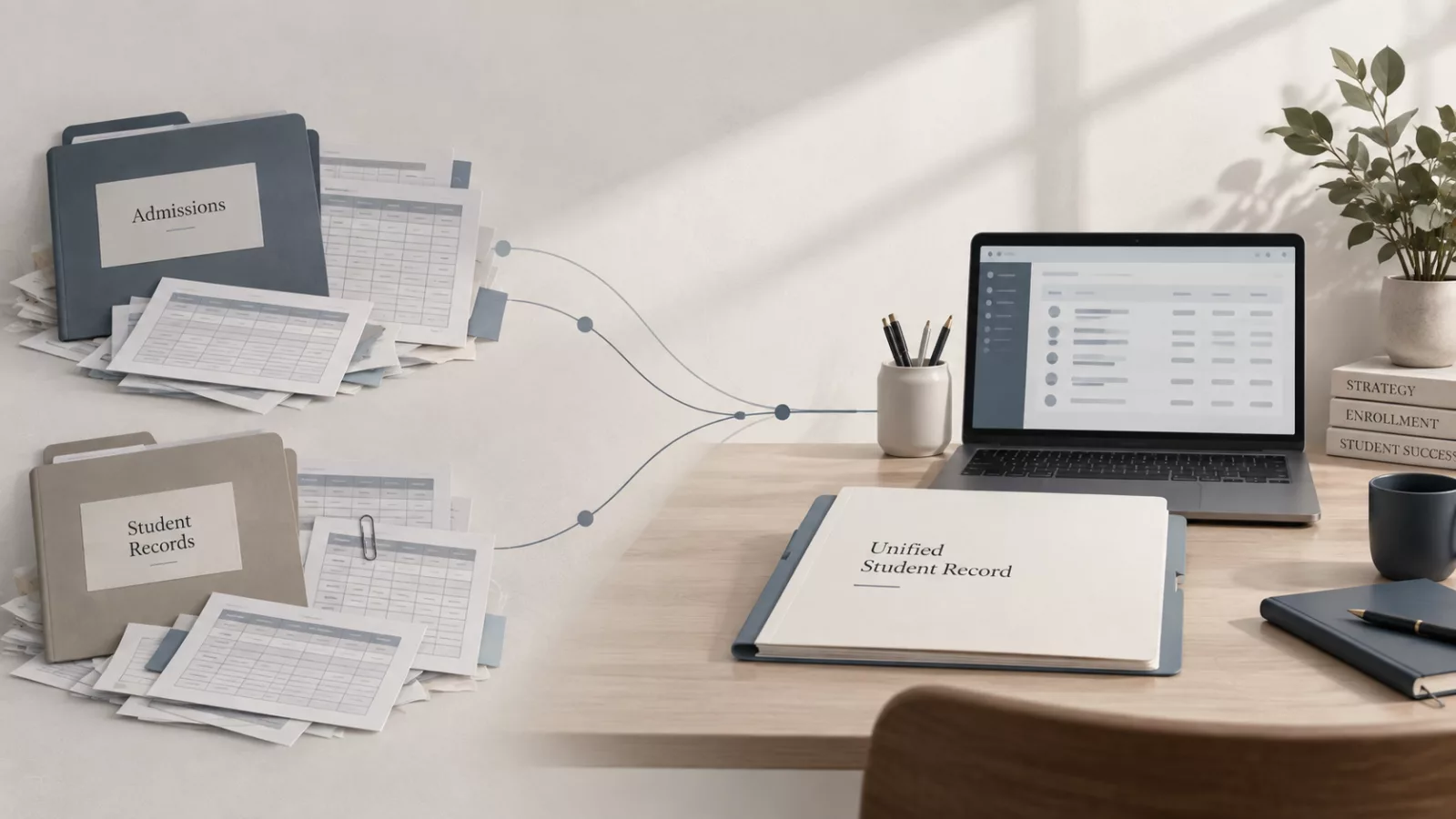
Your admissions director reports 42 enrollments for the next start. The registrar has 36 students ready to begin. Finance has payment arrangements for 33.
Each team may have counted correctly. They may be using different definitions, different reporting dates, or records that someone still needs to update. Before you can decide whether to increase recruitment spending or adjust staffing, you need someone to reconcile the numbers.
For career and postsecondary schools, disconnected CRM and SIS data creates costs through repeated administrative work, delayed intervention, and decisions based on incomplete student information. School leaders feel those costs when they try to establish who will start, where revenue stands, and which programs need attention.
Staff spend time rebuilding the same picture
An admissions CRM tracks prospective students, applications, and recruitment activity. A Student Information System, or SIS, manages enrolled students’ academic and administrative records.
When those systems operate separately, staff may need to copy information, match records, and confirm status changes between departments. A program change recorded by admissions may still need an update in the registrar’s system. Finance may need another confirmation before revising a payment schedule.
You can measure part of this cost with a simple calculation:
Monthly reconciliation cost = hours spent reconciling records × loaded hourly staff cost.
For illustration, 20 hours a month at $35 per hour equals $700, or $8,400 a year. That is a hypothetical calculation, not a CampusLogin customer result. Use your school’s actual hours and employment costs.
Include the time managers spend reviewing discrepancies. Otherwise, you will undercount the work required to produce a report leadership can use.
Enrollment counts can distort operating decisions
A student who signs an agreement, a student who completes registration, and a student who attends the first class represent different stages.
If departments treat each stage as “enrolled,” you can overestimate the next start. You might schedule additional instructor hours or reduce recruitment activity before enough students are ready to attend.
Agree on the definitions first. Then establish who updates each status and when. Connected CRM and SIS software supports that process, but your team still needs consistent rules for recording applications, enrollments, starts, and withdrawals.
For a multi-campus school, apply those rules across locations. Otherwise, a campus comparison may reflect different counting practices as much as different performance.
Separate records make intervention harder
Consider a student who misses classes and falls behind on payments. An instructor sees the attendance issue. Finance sees the balance. Student services may have a conversation that explains both.
With separate records, each department can respond to its own piece of the situation without seeing the broader context. Staff may duplicate outreach or spend time locating the colleague who has the missing information.
School leaders need a way to review attendance, finances, and communication history together, with access appropriate to each role. That helps staff coordinate their next action. It also gives managers a clearer basis for deciding which cases require attention.
Measure the cost before choosing software
Before reviewing CRM and SIS for career schools, ask your departments to track reconciliation work for one reporting cycle.
Record the hours spent matching student records, resolving enrollment discrepancies, and assembling leadership reports. Note how long it takes a status change to reach the next department.
Keep labor costs separate from possible revenue effects. A delayed payment, a missed start, and a withdrawal require different evidence before you can attribute them to disconnected systems.
During a software demonstration, follow a sample student from inquiry through enrollment and into attendance and finance records. Ask the provider to show which information carries forward, which updates require staff action, and how your managers would produce a report for an upcoming start.
How CampusLogin supports connected school operations
CampusLogin, Great Exposure’s CRM and SIS platform for postsecondary institutions, offers a Leads CRM, a Student SIS, and a combined CRM + SIS bundle. The bundle connects recruitment and student management within one platform. It also provides communication histories and tracking for no-shows, dropouts, and outstanding payments.
Great Exposure serves career colleges, vocational and trade schools, and other postsecondary institutions across Canada and the United States. CampusLogin includes departmental configuration, a dedicated account manager, and training to help teams establish their workflows. Explore CampusLogin’s setup and capabilities.
Bring one report your team struggles to reconcile to a CampusLogin demo. Ask to see how your staff would build it, maintain the underlying records, and use it before the next class start.